The Potential Relationship Between Artificial Intelligence and Blockchain
Explore the complex and often conflicting relationship between Artificial Intelligence and Blockchain technology. This post delves into how AI's data-driven nature clashes with Blockchain's immutable data principles, questioning the feasibility of their integration for secure data solutions.
Note: In this article, blockchain technology is primarily considered in the context of Bitcoin.
As someone who has had the opportunity to work in both artificial intelligence and blockchain, and experiment with various projects, I’ve long wanted to write about the potential relationship between these two fields.
At first glance, the most obvious idea that comes to mind is:
“Using artificial intelligence with secure data storage provided by blockchain.”
However, there’s a deeper issue here—one that, in my view, pushes the integration of AI and blockchain toward near impossibility.
Understanding the Nature of Both Technologies
Let’s start by briefly simplifying both concepts.
Artificial intelligence is fundamentally a data-driven technology. Its purpose is to process raw or unstructured data and transform it into meaningful outputs. In that sense, AI cannot exist independently of data.
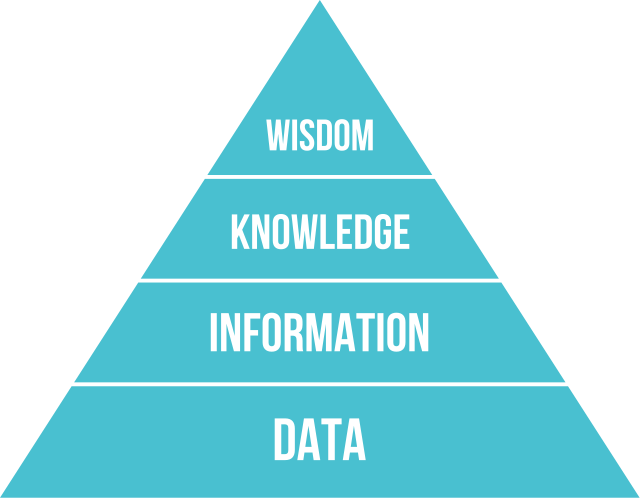
A common framework that explains this process is:
Data → raw, unprocessed input
Information → processed and contextualized data
Knowledge → actionable understanding derived from information
Wisdom → decision-making based on knowledge
Example
Data: A traffic light is red
Information: The second traffic light on Street Y in City X is red
Knowledge: I should stop at that light
Wisdom: I make a safe driving decision based on this knowledge
In this chain, everything begins with data. Without it, AI systems cannot function or make decisions.
The Nature of Blockchain
Now let’s look at blockchain.
Blockchain systems record every action as a transaction inside blocks. These records go through multiple layers of encryption and are stored in a tamper-proof and immutable way.
For example, a query like “How is X written?” could theoretically be stored as a transaction in a block.
Key Characteristics
Encrypted
Immutable
Distributed and validated across multiple nodes
Not directly readable or reversible, even by system participants
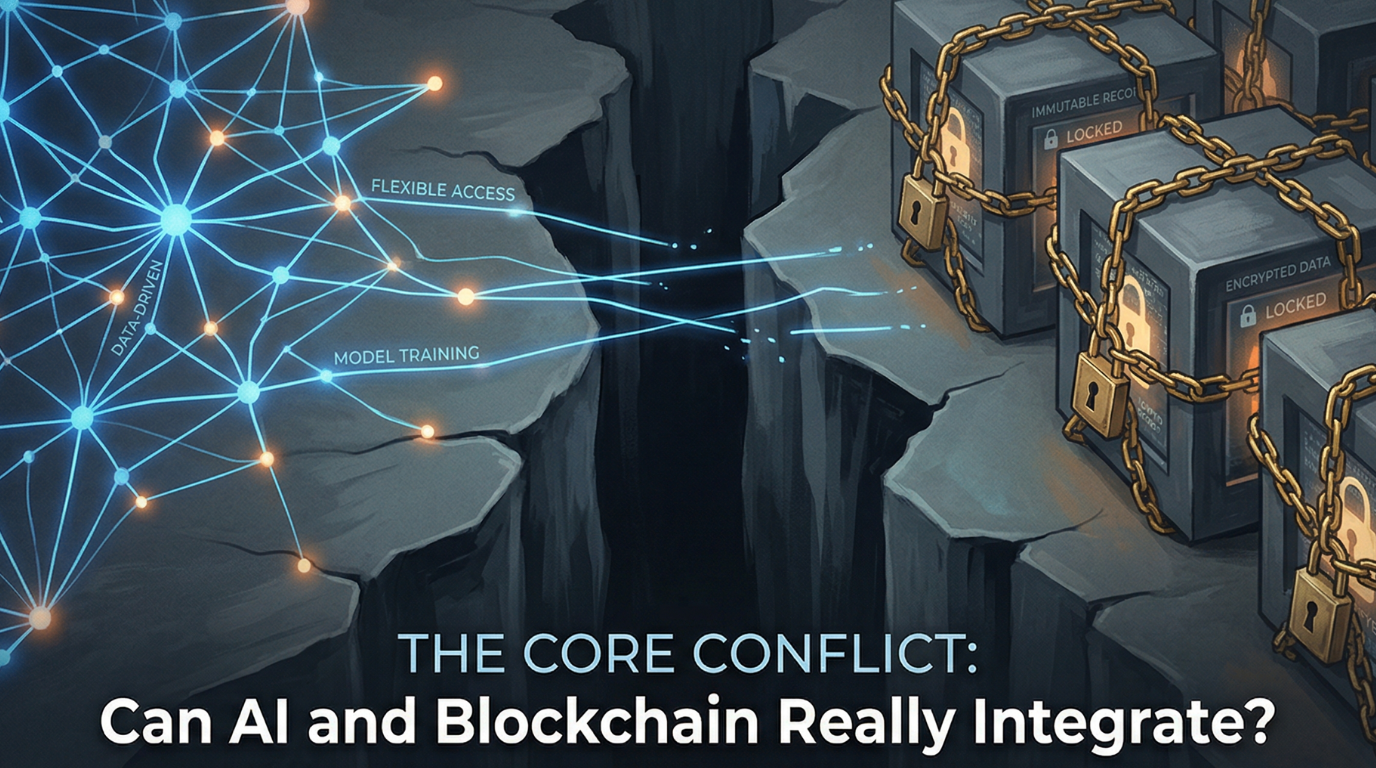
The Core Conflict
This is where the fundamental conflict begins.
AI needs accessible and processable data
Blockchain ensures data is secure, encrypted, and often inaccessible
Can a technology that depends on data operate effectively within a system designed to lock that data down?
Based on research and discussions, this integration appears highly problematic.
Because:
Blockchain enforces immutability and encryption
AI requires flexibility and access to data
These two principles inherently clash.
Are There Any Solutions?
There are ongoing research efforts trying to bridge this gap.
Example
Homomorphic Encryption → allows computations on encrypted data without decrypting it
While promising, these approaches are still limited and do not fully solve the core problem.
Even if we attempt to build datasets on top of blockchain:
Accessing and structuring that data becomes highly complex
Smart contracts are designed for conditional logic execution, not for data extraction and AI training
Data stored on blockchain is not easily accessible for AI systems.
Conclusion
Despite the appealing idea of combining AI’s intelligence with blockchain’s security, their fundamental architectures are in tension.
Until we solve the problem of processing encrypted and immutable data efficiently, the integration of these two technologies will remain limited and challenging.